The Travel Princess Paradox: Are We Misunderstanding Feminism?
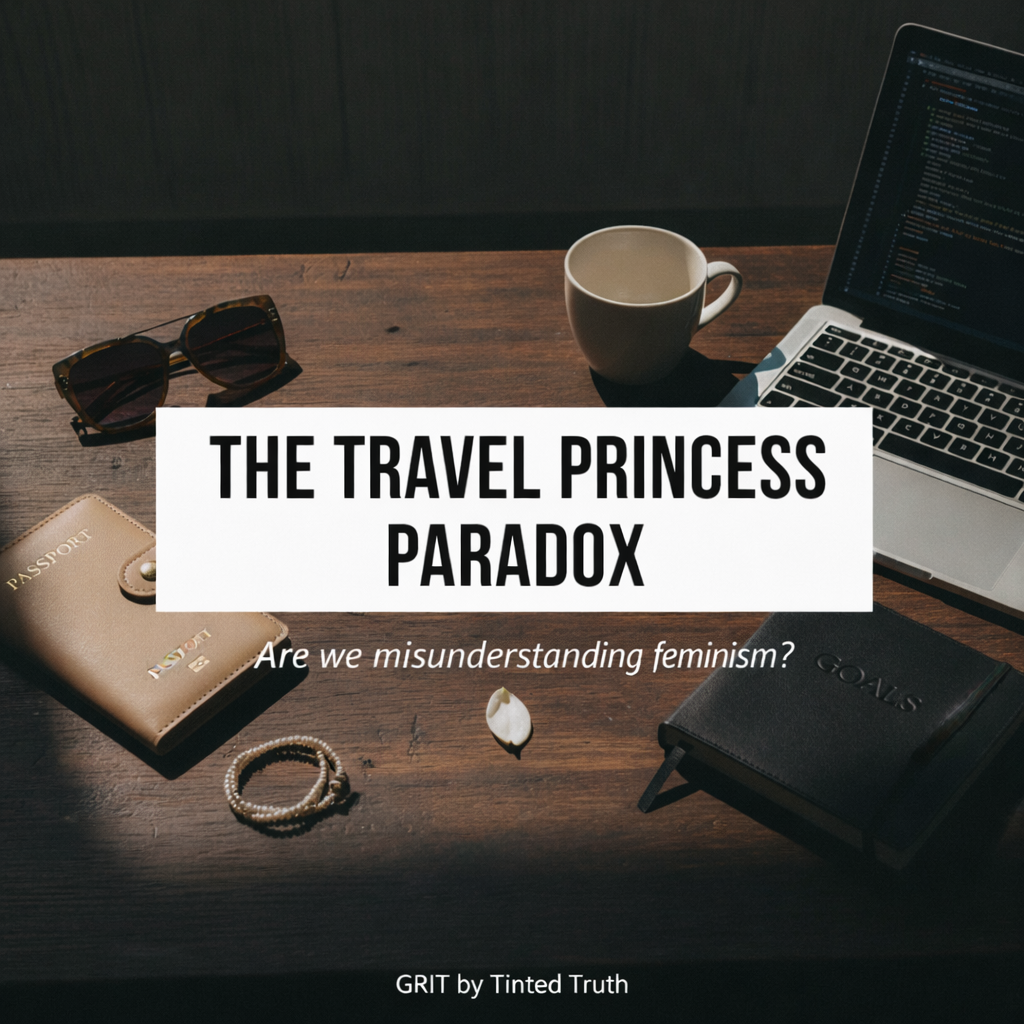
I was sitting on a luggage trolley at the airport, on our way to Goa for Valentine’s Day, watching my husband move through the chaos of bags, boarding passes, and rental car calls. I remember feeling completely relaxed, happy, and if I’m being honest – a little like a travel princess 👑.
And that’s when the thought hit me.
For all the conversations we have today about independence and equality, there are still moments where traditional roles feel comforting. There are still things many of us quietly expect our partners to do. Not because we can’t do them ourselves, but because somewhere deep within us, those gestures still feel natural.
As someone who believes strongly in equality, that realization made me pause.
Was this simply partnership?
Or was I leaning into a norm because it was convenient?
Patriarchy, after all, isn’t just something that exists outside us. It is embedded in culture, upbringing, and often in our own expectations sometimes so subtly that we don’t even notice it. No matter how independent or strong a woman becomes, there are still moments where traditional dynamics resurface, not as oppression, but as comfort.
And that is where the confusion begins.
Because somewhere between empowerment and expectation, the lines of feminism today have started to blur.
Are we misunderstanding feminism? Or are we simply redefining it in ways we haven’t fully examined yet?
💭 Feminism, Equality, and the Conversations We Avoid
Feminism means different things to different people today, and that is exactly where the confusion begins.
This is not an argument against feminism. If anything, it is an attempt to return to what feminism originally stood for – equality, dignity, and fairness and to question whether somewhere along the way we have started redefining it in ways that contradict its original purpose.
Because today, feminism is no longer one shared idea. It has become many interpretations of the same word, and not all of them mean the same thing.
📖 The Different Layers of Feminism
Feminism didn’t emerge all at once. It evolved in response to the inequalities of its time.
My great-grandmother probably fought for basic legal rights.
My grandmother fought for the freedom to exist beyond just domestic roles.
My mother challenged stereotypes, she did not want to fit into a bookish definition of what a woman should be. She just wanted to live, at least a little, on her own terms and more than that she wanted to fight whoever tried to obstruct her daughters path.
And then there is me.
I want more than all of that.
I want equality in opportunity, in perception, in how we are seen and heard.
And I also expect people around me to be more aware.
Maybe that’s what feminism looks like today – not just fighting systems, but pushing beyond the limits placed on us, even subtly.
Feminism has been through so many avatars, I am not even sure we are all talking about the same thing anymore.
Somewhere between the boardroom wins and the Instagram aesthetics, it started meaning very different things to different women and not all of them agree.
Some women talk about independence.
Some talk about softness.
Some reject men completely.
Some want a man to book their flights and carry their bags.
And somehow… all of it is being called feminism.
🧠 The Reality We Come From
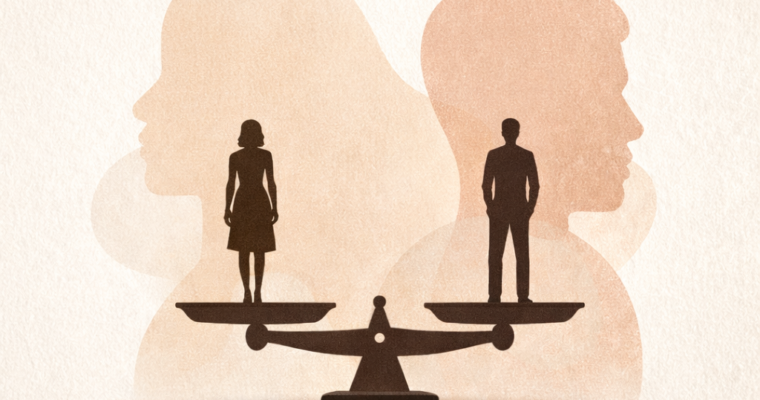
For centuries, societies across the world were structured around male dominance. Men were often seen as decision-makers and leaders, while women were expected to operate within defined roles.
Even today, many of these assumptions exist quietly in the background.
I actually tested this myself. I asked ChatGPT to generate a caricature of me as a consultant, it already knew I was a woman. It gave me a man in a suit. I laughed first. Then I sat with it for a minute. Because that’s exactly how quiet bias works – it’s not malicious, it’s just… assumed.
Well, I asked chatgpt about the image on the left and the explanation was simple. It reflected what a “typical consultant” looks like based on existing patterns (Ignore my 3 hands in the image)

And that is exactly the point.
Bias today is rarely intentional. It is inherited. Technology learns from society, and society still associates certain roles with certain genders. Feminism, at its best, questions these invisible assumptions, not to assign blame, but to expand what we consider normal.
⚖️ Effort, Expectations, and Double Standards
Equality becomes most interesting when it enters everyday situations.
A common argument in modern conversations and a frustrated voice note I got from my friend, the very morning I was writing this – that men should pay on the first date (Her hinge date asked for half the bill) because women put more effort into getting ready – makeup, clothes, or preparation.
But isn’t effort subjective?
A man, too, may be giving up comfort, personal time, or leisure, making the effort to show up presentable, planning the evening, and investing energy into the interaction. Effort simply looks different from each side.
The question here is not about money. It is about consistency.
If equality means shared independence and shared responsibility, then traditional expectations deserve to be questioned as well. Otherwise, we risk keeping the parts of tradition that benefit us while rejecting the parts that don’t. Convenient, right?
🔍 The Problem With Selective Equality
Modern conversations sometimes turn equality into convenience, applying it where it benefits us and ignoring it where it doesn’t.
But equality cannot be situational. It cannot mean equal opportunity in careers but traditional expectations in relationships. It cannot mean rejecting stereotypes in one context while reinforcing them in another.
The intention here is not to criticize women or men individually, but to recognize how deeply social conditioning shapes all of us.
🌿 So What Is Feminism, Really?
At its core, feminism was never about proving that women are better than men. It was about ensuring that gender does not determine opportunity, respect, or value.
Perhaps what feminism needs today is not reinvention, but clarity – a reminder that empowerment does not come from reversing dominance, but from removing it entirely.
✅ A Simple Framework Going Forward
I don’t think we need a framework.
Just a little more honesty.
About where we want equality.
Where we want comfort.
And where we are still benefiting from things we don’t question enough.
I still let my husband handle the airport chaos and I still feel good about it. But I also negotiate my own salary, call out bias when I see it, and refuse to pretend I don’t notice the double standards. Maybe that’s what feminism actually looks like up close —- not a perfect ideology, but an ongoing, slightly uncomfortable conversation with yourself
Maybe all we need is to not confuse equality with advantage.
Not reject softness just to prove strength.
And not assume competence based on gender – in either direction.
And maybe for men, it’s not about “losing identity” or “giving up space.”
It’s just about recognising that fairness doesn’t take anything away, it just removes what was never meant to be uneven in the first place.
💬 Breaking the Bubble
Feminism began as a fight for dignity and fairness. That fight still matters.
But for it to remain meaningful, we need honest conversations, even uncomfortable ones.
Because equality was never meant to divide us. It was meant to make space for everyone.
Maybe feminism today isn’t about having all the answers. Maybe it’s about being honest enough to question our own expectations too.
Because sometimes equality isn’t about doing everything ourselves. Sometimes it’s about understanding why certain things still make us feel cared for.
Maybe being a travel princess for a moment doesn’t contradict equality after all.
Maybe it simply reminds us that equality was never meant to remove care – only hierarchy.
And maybe that conversation is still evolving. I would love to hear what you think
If this resonated, you’ll want to read this next → Should We Preserve 25% of Patriarchy?
1 thought on “The Travel Princess Paradox: Are We Misunderstanding Feminism?”